
MINDSET AND PRACTICE FOUR: Leading in Radical Complexity: Evolving Leader Identity
Jun 12, 2026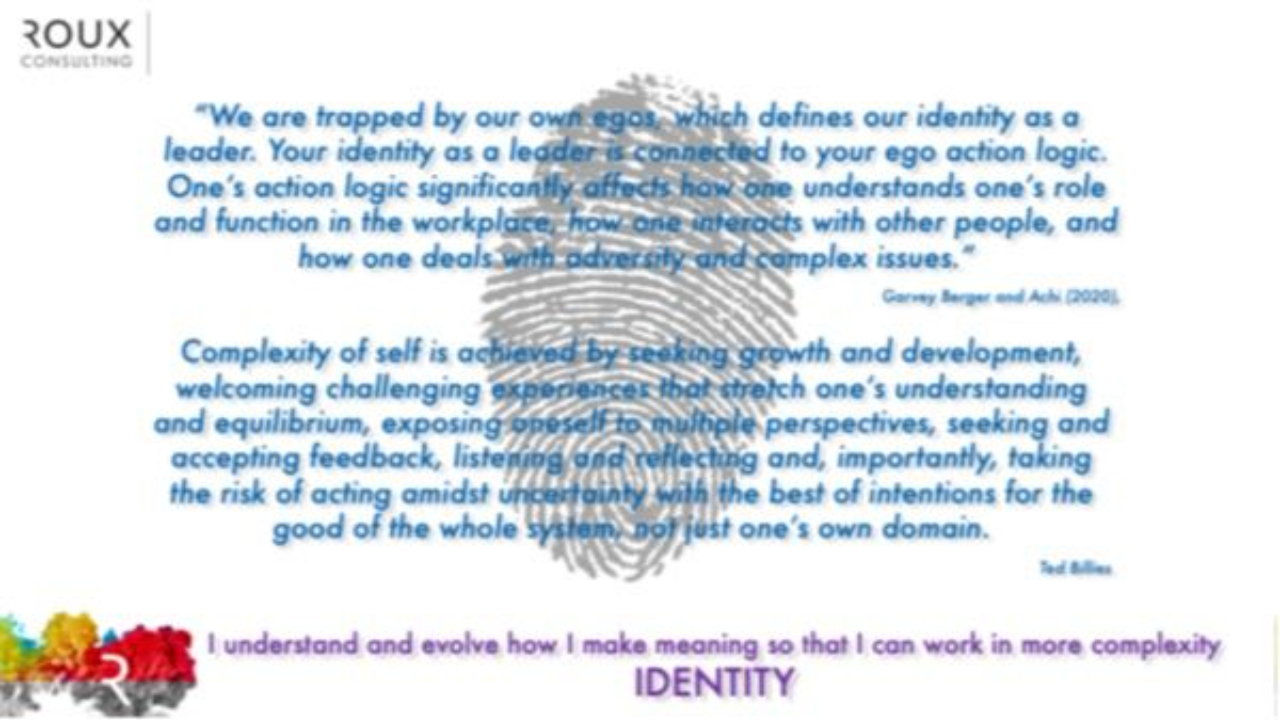
In Blog 1, we explored contextual intelligence: making sense of the world around us.
In Blog 2, we turned inward to personal agility and curiosity.
In Blog 3, we examined ethical and moral maturity.
Now, in Blog 4, we consider a deeper question: Who must I become as a leader to navigate radical complexity?
In radical complexity, yesterday’s leadership identity is insufficient for tomorrow’s challenges. By evolving from expert to achiever to strategist, and from linear thinker to systems thinker, leaders expand their capacity to create clarity, resilience, and transformation in uncertain times.
Leadership as an Evolving Identity
Leadership is not a static skill set: it is an evolving identity. As challenges grow in scale and complexity, leaders must expand how they see themselves, how they see others, and how they see systems.
Robert Kegan’s theory of adult development, and Bill Torbert’s “ego action logics,” remind us that leaders evolve through stages including:
- Expert: defined by mastery of knowledge and skill.
- Achiever: focused on goals, performance, and results.
- Strategist: capable of holding paradox, shaping culture, and thinking in systems.
Each stage is valuable, but each has limits. Complexity often exposes those limits and calls leaders into the next stage. One of the critical new skillsets and mindsets is moving from linear to systems thinking. That often means slowing down and co-creating with others. It means being comfortable with not knowing all the answers and with evolving answers, experiments and learning.
Theo Dawson’s work emphasizes that leaders must move from linear problem-solving to systems thinking: the ability to see interdependencies, feedback loops, and unintended consequences. In a connected world, linear fixes often create new problems. Systems thinkers anticipate ripple effects.
How Do Leaders Evolve?
Identity evolution doesn’t happen overnight. It happens through deliberate practice, reflection, and feedback. Leaders can accelerate their growth by:
- Seeking disorienting dilemmas. Growth often begins when reality disrupts our current way of thinking. Welcome stretch assignments and new perspectives.
- Engaging in reflection. Journaling, coaching, and peer dialogue help leaders examine not only what they do but who they are becoming.
- Practicing systems mapping and sense making. Visualize interconnections and long-term consequences of decisions with others to gather and make sense of multiple perspectives.
- Shifting time horizons. Ask: What matters this quarter? This year? This decade? Expanding your view sharpens your leadership lens.
- Valuing the next stage. Instead of clinging to past strengths, intentionally practice the behaviours of the level above your current one.
A Call to Action
The most important leadership question is not just What should I do?, but Who am I becoming?
What stage of leadership identity are you operating from today and what practices will help you step into the next stage?
Lorem ipsum dolor sit amet, consectetur adipiscing elit. Cras sed sapien quam. Sed dapibus est id enim facilisis, at posuere turpis adipiscing. Quisque sit amet dui dui.
Stay connected with news and updates!
Join our mailing list to receive the latest news and updates from our team.
Don't worry, your information will not be shared.
We hate SPAM. We will never sell your information, for any reason.
