
MINDSET AND PRACTICE ONE: Leading in Radical Complexity: Contextual Intelligence and the Art of Seeing Around Corners
Jun 12, 2026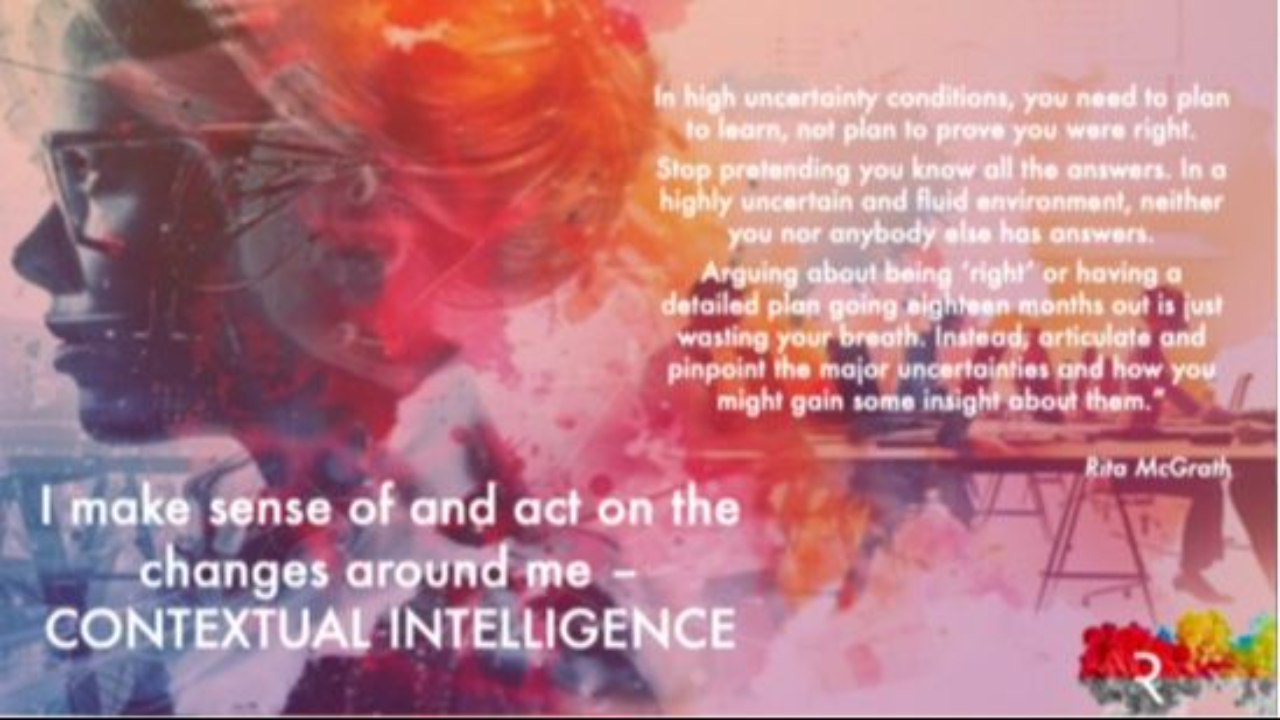
MINDSET AND PRACTICE ONE: Leading in Radical Complexity: Contextual Intelligence and the Art of Seeing Around Corners
When environments are stable, leaders can rely on expertise, past experience, and standard playbooks. But in complex or radically uncertain conditions, the past is a poor predictor of the future. What worked before may not work again. This is where contextual intelligence, sensemaking, and the ability to see around corners become indispensable.
For leaders, this reality raises a profound question: how do I make sense of what’s happening around me and act wisely in the face of radical uncertainty? The answer begins with the consistent practices of contextual intelligence, sense making and seeing around corners.
What is Contextual Intelligence, Sense Making and Seeing Around Corners?
- Contextual Intelligence (Matthew Kutz)
Kutz describes contextual intelligence as knowing the limits of your knowledge and adapting accordingly. Leaders are often swimming in data, but information alone doesn’t guarantee insight. Contextual intelligence is the ability to filter and know which data matters most right now, how to interpret it against the backdrop of shifting conditions, and when it’s time to pivot. It’s the difference between a leader who drowns in dashboards and one who discerns the single leading indicator that actually matters. - Sensemaking (Deborah Ancona)
MIT’s Deborah Ancona calls this process sensemaking: creating maps in uncharted territory so teams can move forward together. In times of disruption, people crave clarity, but clarity doesn’t always exist. Leaders can’t provide certainty, but they can help their teams co-create understanding. By gathering diverse perspectives, testing assumptions, and building provisional “maps,” leaders empower others to navigate ambiguity with confidence. Sensemaking isn’t a one-time activity; it’s a continuous cycle of scanning the environment, updating mental models, and communicating what’s known and what isn’t. - Seeing Around Corners (Rita McGrath)
Rita McGrath adds another dimension: the ability to see around corners. Inflection points like technological shifts, market changes and cultural movements rarely arrive fully formed. They begin as weak signals. Leaders who train themselves to notice patterns early can position their organizations to act before the shift becomes obvious to everyone else. This isn’t about predicting the future with precision but about developing a sensitivity to emerging possibilities and a willingness to experiment in advance of certainty.
The Integrated Mindset
Together, these three ideas outline a discipline for modern leadership:
- Scan continuously for weak signals.
- Interpret with contextual intelligence: knowing what matters and what doesn’t in the moment.
- Act with agility, experimenting as you sense possible inflection points.
This mindset reframes leadership not as heroic foresight, but as disciplined attentiveness. It’s less about commanding from the top, and more about guiding the collective through shifting terrain. Leaders who practice contextual intelligence, sensemaking, and “seeing around corners” aren’t just reacting to change; they are cultivating the capacity to thrive in it.
Practices to Build Contextual Intelligence
Here are a few tools and habits leaders can cultivate:
- Widen the lens. Regularly step outside your usual industry echo chamber. Scan adjacent sectors, fringe competitors, and emerging technologies.
- Listen for weak signals. Pay attention to anomalies, small experiments, and unexpected behaviours that may point to big shifts.
- Engage diverse perspectives. Invite voices from different functions, geographies, and generations. Sensemaking is stronger when we draw on multiple maps.
- Run small bets. Rather than waiting for certainty, test ideas quickly. McGrath reminds us that real options thinking can help you probe the future without betting the company.
- Pause to reflect. In the rush of execution, make time to ask: What is changing? What might it mean? What could we be missing?
Put together, these practices help leaders avoid two traps of uncertainty: overconfidence (clinging to false certainty) and paralysis (doing nothing until it’s too late). Instead, they foster a dynamic posture of scanning, interpreting, and acting in cycles. Leaders who adopt this mindset don’t eliminate uncertainty, but they make it less threatening. They create organisations capable of learning faster than the environment changes.
A Call to Action
As leaders, your team doesn’t just look to you for answers. They look to you for clarity amid complexity. Practicing contextual intelligence won’t eliminate uncertainty, but it will equip you and your people to navigate it with agility and confidence.
What signals in your environment are you paying attention to or ignoring that could change the game?
Lorem ipsum dolor sit amet, consectetur adipiscing elit. Cras sed sapien quam. Sed dapibus est id enim facilisis, at posuere turpis adipiscing. Quisque sit amet dui dui.
Stay connected with news and updates!
Join our mailing list to receive the latest news and updates from our team.
Don't worry, your information will not be shared.
We hate SPAM. We will never sell your information, for any reason.
